
A War of Annihilation Against Israel Without Israel—The National Museum Responds
The exhibition “We and the War” is currently on view at the Zurich State Museum. Among other topics, it explores refugee movements resulting from armed conflicts. In connection with the First Arab-Israeli War of 1948–1949—in which five Arab armies attempted to wipe out the newly founded Jewish state—the Zurich State Museum replaced the reference to “Israel” with “Palestine.” This was done even though no such state exists to this day and the war took place on Israeli territory. Following an intervention by FokusIsrael.ch, those responsible agreed to correct the entry.
By Sacha Wigdorovits
In the exhibition “We and the War,” the Zurich State Museum explores Swiss and international refugee movements since the 16th century resulting from armed conflicts. In addition to World War I (1914–18) and World War II (1939–45) , these include the Hungarian Uprising (1956), the Tibetan Uprising (1959–65), and the Prague Spring (1968). These events are depicted on a large timeline.
Between World War II and the Hungarian Uprising, the First Arab-Israeli War is also noted there. It began in 1948 immediately after the proclamation of the Jewish state, when the armies of Egypt, Jordan, Syria, Lebanon, and Iraq invaded Israel to destroy the new state. The war ended in 1949 with ceasefire agreements.
On the overview chart at the National Museum, which depicts all major military events since the year 1500, this entry reads as follows:
1948–
Palestine and Gaza
Middle East Conflict
Hostilities
This entry is incorrect in several respects. While it is true that, as a result of the war against Israel in 1948 and 1949, approximately 700,000 Arabs fled—in part because they were urged to flee by their leaders, such as the Grand Mufti of Jerusalem, Mohammed Amin al-Husseini, to flee, and partly because they were driven out by Israeli forces—but:
- This exodus did not continue until today, as the date “1948–” suggests. Rather, it took place during a clearly defined period from 1948 to 1949.
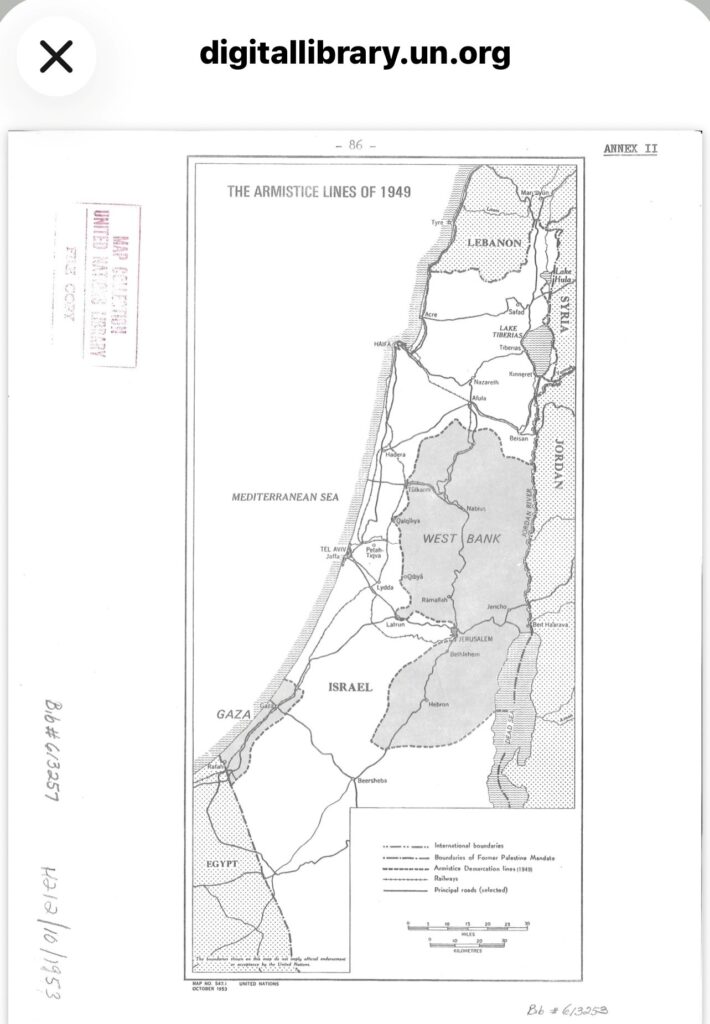
- The exodus did not originate in “Palestine and Gaza.” First, because the territory known as “Palestine” had ceased to exist since the end of the British League of Nations Mandate of the same name. The territory was officially called “Israel,” as is evident from the UN map of that time. Second, because there was no exodus from “Gaza”; on the contrary, the refugees fled to Gaza (and the West Bank), where they have remained to this day.
- The correct term for the armed conflict at that time is “First Arab-Israeli War” or “Arab-Israeli War.” The term “Middle East conflict” is misleading and anachronistic in this context because none of the subsequent armed conflicts between Israel and its Arab neighbors—such as the Suez Crisis (1956), the Six-Day War (1967), and the Yom Kippur War (1973)—there were no longer such large-scale refugee flows. (Not to mention that the term “Middle East conflict” was not even in use in 1948; it only came into use in 1967.)
Political Preferences Instead of Historical Facts?
The accumulation of all these errors gave the impression that, in describing the armed conflict of 1948–49, the exhibition organizers had been guided not by historical facts but by their (pro-Palestinian) political preferences.
In response to an inquiry from FokusIsrael.ch, the National Museum denied that political preferences had influenced the wording. It did, however, acknowledge “that, in the context of the wall graphic, this term (‘Palestine,’ Ed.) is historically ambiguous and may be misleading.” Therefore, the museum promises, it will “adjust the entry on the wall display.”
This is a welcome development, especially since the necessary adjustment is straightforward. To be accurate—and to align with the other entries on the timeline—it should simply read:
1948–1949
Israel
First Arab-Israeli War
War violence
In doing so, the National Museum would demonstrate that it is engaged in historical analysis rather than (anti-Israeli) politics.
Sacha Wigdorovits is President of the Fokus Israel und Nahost association, which runs the website fokusisrael.ch. He studied history, German and social psychology at the University of Zurich and has worked as a US correspondent for the SonntagsZeitung, was editor-in-chief of BLICK and co-founder of the commuter newspaper 20minuten.
Have you discovered an error?